
When you or a loved one require a mobility scooter, powerchair or wheelchair to move freely, it can be limiting when it's time to leave the house and bring your mobility device with you. Oftentimes, there is not enough cabin space in the car to accommodate your device, and you're left with few options:
- Remain at home, which is not realistic if you have medical appointments you have to travel to.
- Rely on scooters that can be disassembled for transport, which can be impractical if don't have a caregiver who is able to easily break down and reassemble the device.
- Rely on smaller, inadequate wheelchairs or scooters that aren't enough for your needs; such as transport chairs with four small wheels, scooters with uncomfortable seats that are not fully padded, or similar.
The best solution when cabin space is limited is to outfit your vehicle with a hitch-mounted mobility carrier. Unlike a typical hitch-mounted cargo carrier for coolers or camping euqipment, these carriers incorporate a loading ramp so that you or your caregiver are not physically lifting any part of the mobility device, and in most cases, you won't have to break down the device at all to get it to fit.
How to Choose the Correct Hitch-Mounted Carrier for Your Vehicle
For a detailed guide, read how to choose the right carrier for your vehicle. The important measurements, weights and information to gather before you shop for a carrier are:
- Your vehicle's hitch class. Most carriers work with a 2" Class III/IV hitch.
- Your vehicle's tongue weight, and read about the limitations of hitch-mounted carriers on certain vehicles.
- Assess your vehicle's suspension
- Your scooter's weight and overall LxWxH measurements
There are also some things that should be considered when thinking through the compatibility between your device, vehicle, carrier, as well as who will be loading the device and if they have any mobility limitations in any way.
Thinking about the loading process is important. Does the person who will be moving your device up the ramp onto the carrier have the strength and dexterity to do so? If not, consider an electric lift/carrier, which allows you to drive on and raise the carrier up with the push of a button.
How to Compare Mobility Carriers
Besides color (usually black or bare metal), it can be very difficult to know how to compare carrier models in a savvy way (even this author often struggles with it, and I've been working with these products for half a decade).
The key points of comparison (and why they're important):
- Affordability: The range is considerable, from $150 to $400, and each person has a different budget.
- Basket size: Larger mobility scooters require more room.
- Ramp length: The longer the ramp, the easier it is to load the scooter.
- Weight: Carriers weigh between 50 lbs. and 150 lbs., and the heavier they are, the less available tongue weight will remain for your scooter.
- Weight capacity: If you ride a full-size scooter that weighs 400 lbs., you'll probably need a carrier with a weight capacity of 500 lbs.
- Any other distinguishing features: Some carriers have pass-through ramps for bilateral loading, or tilt-down platforms that lessen the load angle. Some have no ramp and operate up and down electrically. The more features, the high priced the carrier will be.
Top-Selling Mobility Scooter Carriers on Mobilit Mart
Our curated assortment of hitch-mounted carriers has something for everyone.
| Silver Spring Standard Steel Carrier | Silver Spring Deluxe Steel Carrier | Silver Spring Standard Aluminum Carrier | Silver Spring Deluxe Aluminum Carrier | Tilt-A-Rack Premium Aluminum Carrier | Tilt-A-Rack Mini Aluminum Carrier | Tilt-A-Rack Medium Aluminum Carrier | Tilt-A-Rack Full-Size Aluminum Carrier | |
| Model # | SC400-V2 | SC500-V3 | WCC-500A | SC500-AF | TWSC-350 | 350ARV-Mini | 350ARV | 500ARV |
| Affordability | $ | $ | $ | $$ | $$ | $$ | $$ | $$$ |
| L x W Overall | 48" x 27.75" | 48" x 28" | 48" x 28" | 48.25" x 32.25" | 52.75" x 27.75" | 44" x 24" | 52" x 26" | 60" x 32" |
| L x W Basket | 47.5" x 27.5" | 47.5" x 27.5" | 48" x 27.75" | 47" x 29.5" | 52" x 27.6" | 44" x 24" | 52" x 26" | 60" x 32" |
| Ramp Type | Single Fold | Bi-Fold | Single Fold | Bi-Fold | 2-Way Pull-Out w/Tilt | Pull-Out w/Tilt | Pull-Out w/Tilt | Pull-Out w/Tilt |
| L x W Ramp | 42" x 27.5" | 59.1" x 27.5" | 45.6" x 27.75" | 59.25" x 29.25" | 46" x 27.25" | 36.75" x 24" | 44.5" x 24" | 52.5" x 32" |
| Weighs | 71 lbs. | 83 lbs. | 56 lbs. | 92 lbs. | 120 lbs. | 86 lbs. | 87 lbs. | 103 lbs. |
| Weight Cap | 500 lbs. | 500 lbs. | 500 lbs. | 500 lbs. | 350 lbs. | 350 lbs. | 350 lbs. | 500 lbs. |
| Material | Steel | Steel | Aluminum | Aluminum | Aluminum | Aluminum | Aluminum | Aluminum |
| Surface Type | Steel Mesh | Steel Mesh | Rung | Rung | Punch Plate | Diamond Plate | Diamond Plate | Diamond Plate |
| Class | III/IV, 2" | III/IV, 2" | III/IV, 2" | III/IV, 2" | III/IV, 2" | III/IV, 2" | III/IV, 2" | III/IV, 2" |
| Carrier Folds Up | ||||||||
| Anti-Rattle | ||||||||
| Biggest Benefits | Most affordable! | Longer ramp = easier loading incline | Lightest for easiest installation & fuel savings! 7.5" Side rails | Largest ramp! 7.5" Side rails Ramp folds | Ramp pulls out in either direction! Platform tilts Easier loading | Most compact! Platform tilts Easier loading | Platform tilts; no need to unfold a ramp Easier loading | Largest platform! Holds larger four-wheel scooters Platform tilts; no need to unfold a ramp Easier loading |
Installing and Using Mobility Scooter Carriers
Although each carrier will come with its own set of instructions, in most cases the installation will be similar across the board.
Basic Installation Guide
- If the carrier arrives unassembled, assemble it per the instructions.
- Prepare your vehicle's hitch receiver (give it a clean, make sure there's no rust or debris that could compromise safety or installation).
- Line up the carrier's hitch tube with the hitch receiver, insert it, and secure it with a hitch pin. In some cases, there will be an anti-rattle device that you will install prior to inserting the hitch tube.
- Make sure everything looks and feels secure before using.
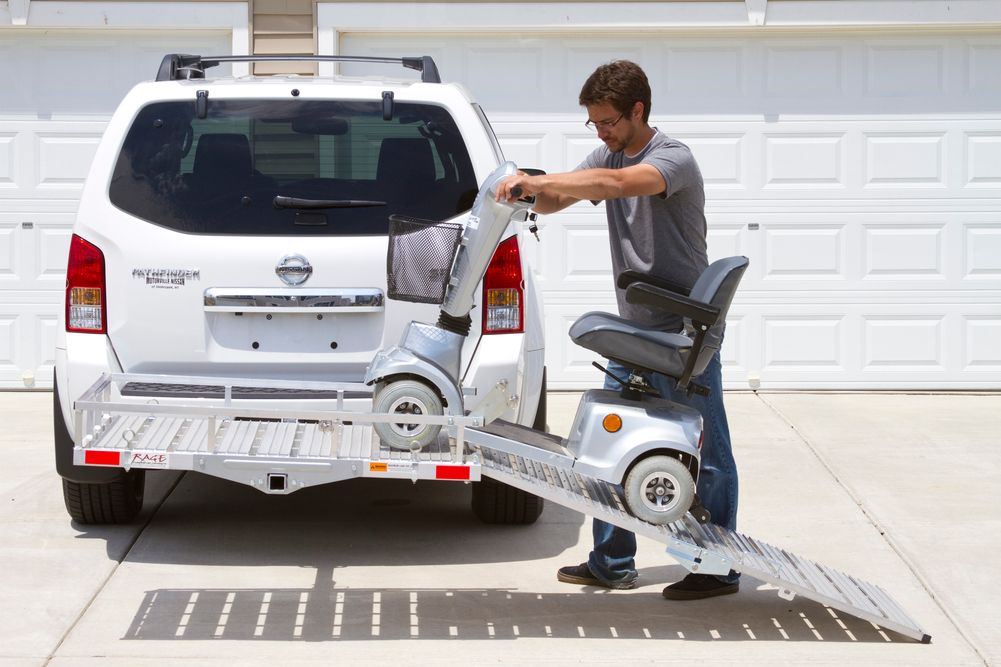
Basic Use Guide
- Each time you plan on using your carrier, you should it look beforehand and test the tightness or any nuts or bolts. If you see anything rusted, broken, or not looking right, DO NOT USE. If you're questioning it, don't use it, and reference your installation manual or user guide for further instructions.
- Lower the ramp according to your carrier's instructions.
- Ride your scooter up to the edge of the ramp so that it's aligned, then get off the scooter.
- While standing beside the scooter, use the handle to make it move forward and up onto the ramp and platform. Never ride a scooter up a ramp onto a carrier! Not only will you risk falling and injuring yourself, but you could also exceed the load limit of your vehicle's tongue weight resulting in damage to your carrier, vehicle, or scooter.
- Turn the scooter off and remove the keys.
- Secure the scooter to the carrier using tie-down straps, then you're ready to drive.
Maintenance and Care for Your Carrier
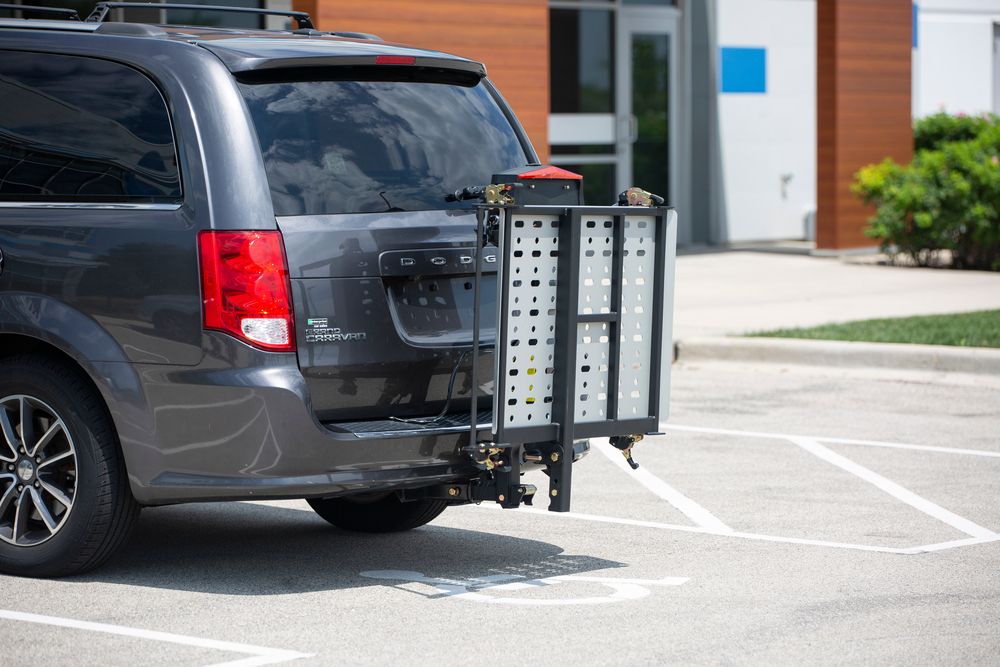
Many mobility carriers have fold-away features that allow them to fold at the hitch tube to reduce the footprint of your vehicle while it's parked. While handy for when you're out and about, when you're at home you might choose to remove your carrier and store it in your garage. Keep it away from moisture and be ready to dust it down if it sits unused for a long period of time.
Cleaning is simple, hose it down or wash it with soap and water.
Other Frequently Asked Questions About Transporting Mobility Scooter
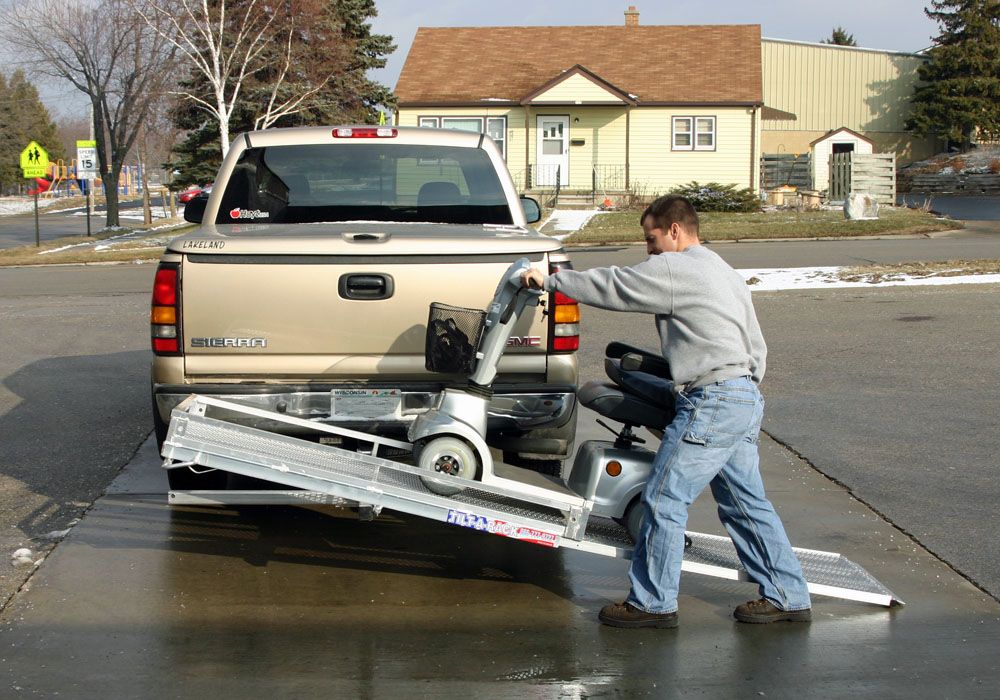
How easy is it to get a mobility scooter into a truck?
It depends on how much energy you are able or willing to exert. The person, or people, getting the scooter into the truck bed must be able to comfortably lift the entire weight of the scooter, which can sometimes be a couple of hundred pounds.
How to get a mobility scooter in and out of a car?
Most cars are too small to fit a mobility scooter within first taking the scooter apart. Mini-vans, crossovers and SUVs have more cabin room, and some allow for scooters to be lifted and placed into the trunk or cabin area (usually with seats folded down or removed).
Can you get trailers for mobility scooters?
Although there is not a large market for trailers specifically for mobility scooters, purchasing a small trailer (open or enclosed), is one way to safely transport your scooter without having to worry about a carrier exerting downward pressure on your hitch.
How can I get a mobility scooter from Medicare?
Each person's needs and coverage differs; please read Medicare's Wheelchairs and Scooters page for additional information.
Disclaimer: This educational article contains general information only; Mobility Mart cannot confirm the compatibility of an individual's vehicle with our hitch-mounted products as every vehicle's suspension is unique. It is the vehicle user's responsibility to confirm the vehicle hitch capacity of the vehicle and weight capabilities when using Mobility Mart products. Discount Ramps cannot be held liable for damage, injuries, or accidents that occur after reading this article.


